Description
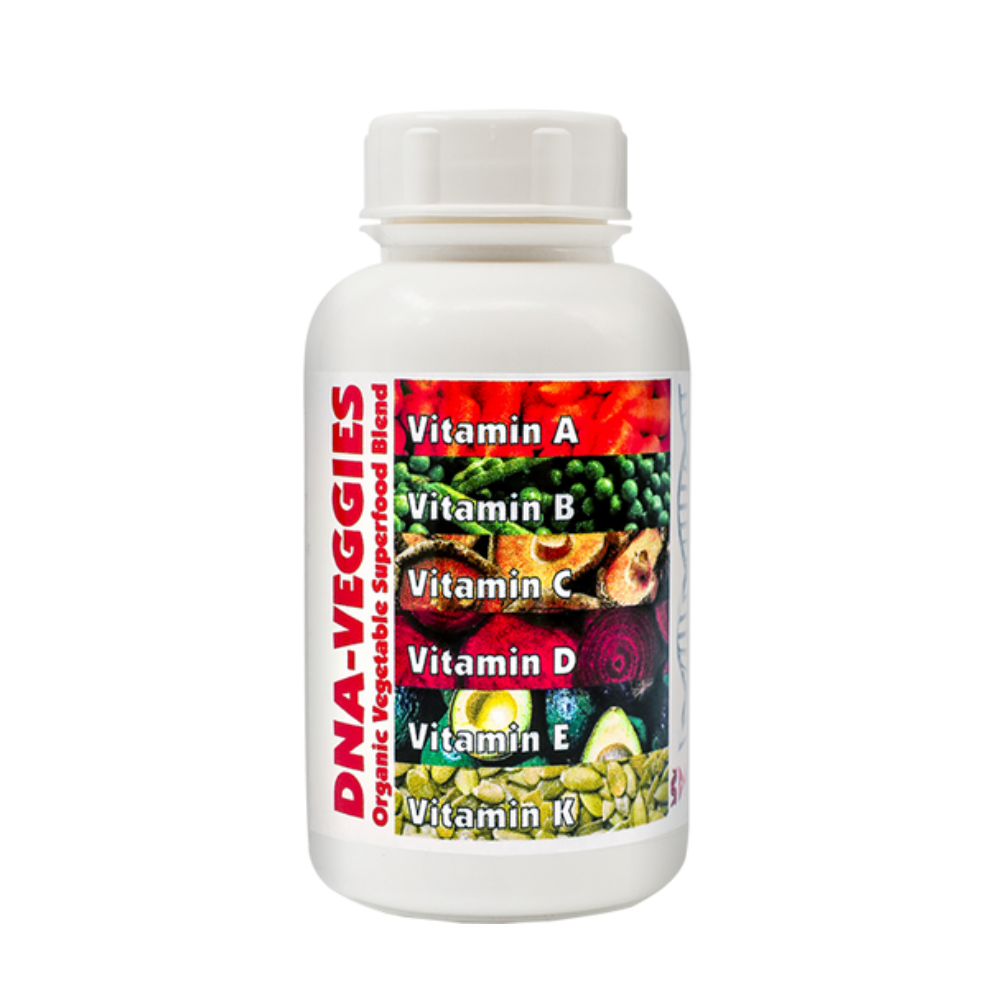
DNA-Veggies (90 Capsules)
The human body is designed to obtain nutrients and energy from food sources. All food consumed is used in one way or another by the body to maintain health and immunity. Our bodies do not absorb synthetic vitamins or absorb them poorly. As crystalline substances, inorganic and devoid of natural elements and proteins, the body sees these as foreign substances which can burden the liver and kidneys. When a synthetic vitamin is taken, the body does not see it as a ‘food source’ and will only absorb a small amount of it. The rest is eliminated in the urine and hence the phrase – “we have the most expensive urine of all mammals”.
When are vitamins best absorbed?
The vitamins found in plants have the form of provitamins, i.e., chemical compounds that are easily absorbed by humans. Their absorbability depends primarily on the presence of proteins in the plants and is enhanced due to the presence of mineral salts. Synthetic vitamins are usually inorganic (crystalline). If deprived of the protein carrier, they cannot be absorbed by the body.
It is not what you eat, but what you absorb, that counts.
We do need vitamins, but only from natural sources, as they are absorbed best and are not accumulated in the body. DNA-VEGGIES contains concentrated extracts from plants, vegetables and fruits. All ingredients are non-GMO, organically grown, and extracted in such a way that the integrity of the plant is preserved. The formula covers a wide range of vitamin needs essential for good health and immunity.
DNA-Veggies Contains the following extracts:
Vitamin A from Carrots – Carrots are well-known for their high content of beta-carotene.
Vitamin C from Amla – Amla contains one of the most concentrated forms of vitamin C found in the plant kingdom.
Vitamin D from Shiitake Mushrooms – (Grown wild. Exposed to UV light. Dried with gills up which greatly increases vitamin D levels.)
Vitamin E from Spirulina and Kale – Spirulina is one of the few plant sources of vitamin B12. It contains protein, vitamins, and minerals and has antioxidant properties. It may help manage inflammation, blood sugar, cholesterol, and blood pressure, among other benefits.
Kale is an excellent source of vitamins C and K, potassium, iron, copper and manganese.
Vitamin K2 from Nattokinase – Nattokinase is a unique food and is well known to be the absolute richest food source of Vitamin K2. Natto contains far more Vitamin K2 than any other food ever tested. About 90% of Natto’s K2 is in MK-7 form, the type of menaquinone which has the strongest evidence for bone health benefits.
Vitamin B1 (Thiamine) from Peas – These nutritious legumes contain various minerals as well as B-complex vitamins such as folate, pantothenic acid, niacin, thiamine and pyridoxine.
Vitamin B2 (Riboflavin) – From Avocado.
Vitamin B3 (Niacin) from Spinach – Spinach is a very good source of carotenoids (beta-carotene, lutein and zeaxanthin), flavonoids (kaempferol and quercetin) and good amounts of iron, calcium, magnesium, phosphorus, potassium, copper and manganese, and vitamins C, E, K, B6, riboflavin, folate.
Vitamin B5 (Pantothenic Acid) from Avocado extract – High in Vitamin K, Folate, Vitamin C, Potassium, Vitamin B6, Vitamin E and also contains small amounts of magnesium, manganese, copper, iron, zinc, phosphorous and vitamins A, B1 (thiamine), B2 (riboflavin) and B3 (niacin).
Vitamin B6 (Pyridoxine) from Broccoli – High level of folate and calcium and a good source of potassium, vitamin C and pyridoxine.
Vitamin B7 (Biotin) from pumpkin seed powder – These nutrient-dense seeds are an excellent source of magnesium, iron, potassium, phosphorous and copper, and a good source of calcium, selenium, zinc, vitamin K, riboflavin (vitamin B2), niacin (vitamin B3), pantothenic acid (vitamin B5), biotin (vitamin B7) and folate (vitamin B9).
Vitamin B9 from Beetroot – An excellent source of dietary nitrate which is transformed in the body to nitric oxide, the biological messenger molecule.
Vitamin B12 – Vitamin B12 is needed to form red blood cells and DNA. It is also a key player in the function and development of brain and nerve cells. Vitamin B12 binds to the protein in the foods we eat.
Supplement Facts (per 600mg Vegi-Cap):
-
Carrot – 50mg
-
Amla – 50mg
-
Shiitake Mushroom – 50mg
-
Spirulina – 50mg
-
Spinach – 50mg
-
Green Pea – 50mg
-
Kale – 50mg
-
Broccoli – 50mg
-
Avocado – 50mg
-
Pumpkin Seed – 50mg
-
Beetroot – 50mg
-
Nattokinase – 50mg
Contains no fillers or preservatives.